
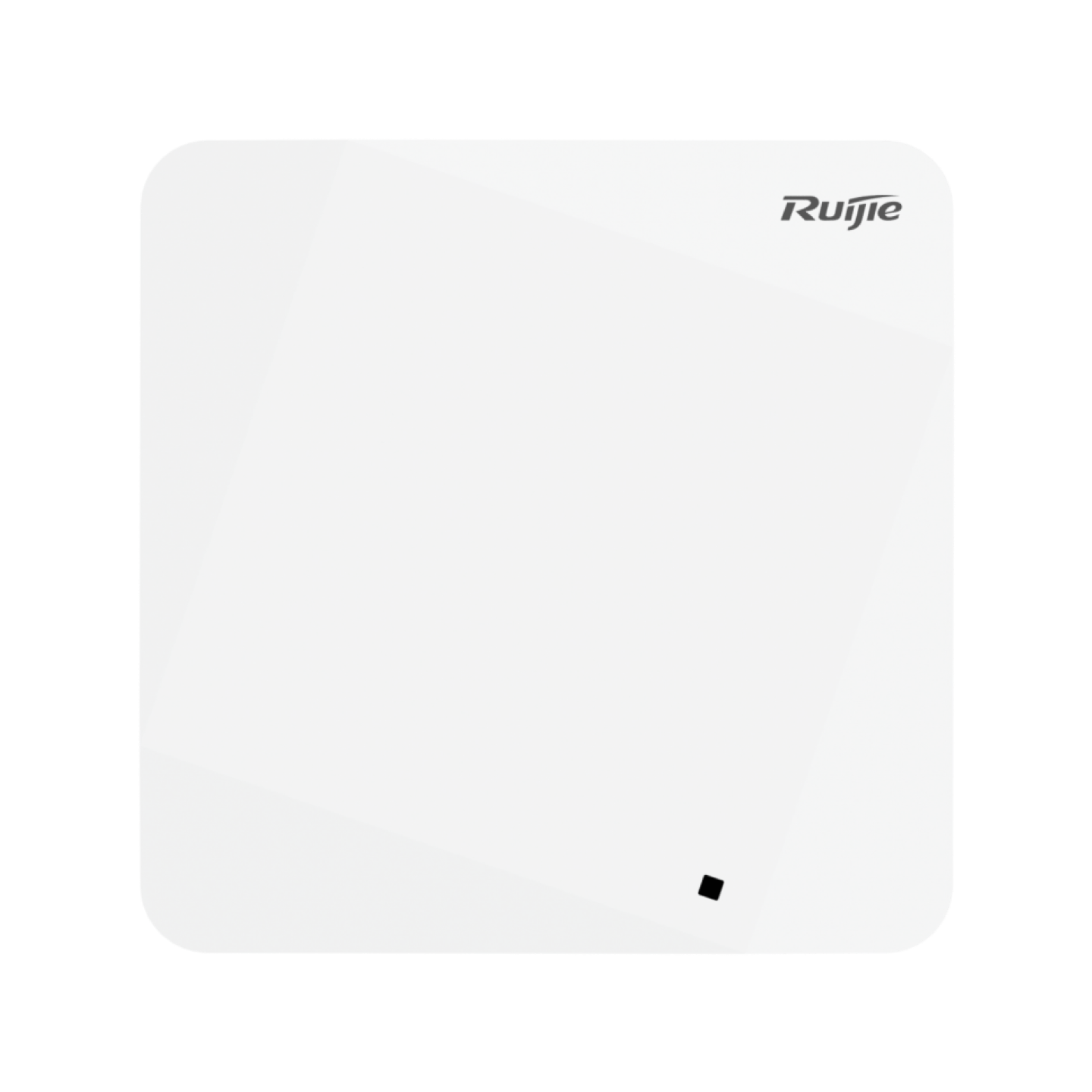


Ruijie RG-AP720-L, Wi-Fi 5 Dual-Radio Access Point
Çift Radio, 1,167 Gbps'ye Kadar Hız
|
Dimensions and Weight |
RG-AP720-L |
|
Unit dimensions (W x D x H) |
194 mm x 194 mm x 37 mm (7.64 in x 7.64 in x 1.46 in) |
|
Shipping dimensions (W x D x H) |
460 mm x 360 mm x 242 mm (18.11 in x 14.17 in x 9.53 in) |
|
Unit weight |
Main unit: 0.42 kg (0.93 lbs) Mounting bracket: 0.07 kg (0.15 lbs) |
|
Shipping weight |
0.87 kg (1.92 lbs) |
|
Mounting |
Wall/Ceiling-mount (a mounting bracket is delivered with the main unit) |
|
Lock option |
Kensington lock and securing latch |
|
Wi-Fi Radio |
RG-AP720-L |
|
Radio design |
Dual-radio and up to four spatial streams: ● Radio 1: 2.4 GHz, two spatial streams, 2x2 MIMO ● Radio 2: 5 GHz, two spatial streams, 2x2 MU-MIMO |
|
Operating frequencies |
Radio 1, 802.11b/g/n: ● 2.400 GHz to 2.4835 GHz, ISM Radio 2, 802.11a/n/ac: ● 5.150 GHz to 5.250 GHz, U-NII-1 ● 5.250 GHz to 5.350 GHz, U-NII-2A ● 5.470 GHz to 5.725 GHz, U-NII-2C ● 5.725 GHz to 5.850 GHz, U-NII-3/ISM Note: Country-specific restrictions apply. |
|
Data rates |
Combined peak data rate: 1.167 Gbps 2.4 GHz radio ● Two spatial stream Single User (SU) MIMO for up to 300 Mbps wireless data rate to individual 2SS HT40 802.11n client devices (max.) ● Two spatial stream Single User (SU) MIMO for up to 144.4 Mbps wireless data rate to individual 2SS HT20 802.11n client devices (typical) 5 GHz radio ● Two spatial stream Single User (SU) MIMO for up to 867 Mbps wireless data rate to individual 2SS HT80 802.11ac client devices (typical) |
|
Data rate set |
The following 802.11-compliant data rates in Mbps are supported: 2.4 GHz radio ● 802.11b: 1, 2, 5.5, 11 ● 802.11g: 1, 2, 5.5, 6, 9, 11, 12, 18, 24, 36, 48, 54 ● 802.11n: 6.5 to 300 (MCS0 to MCS15, HT20 to HT40) 5 GHz radio ● 802.11a: 6, 9, 12, 18, 24, 36, 48, 54 ● 802.11n: 6.5 to 300 (MCS0 to MCS15, HT20 to HT40) ● 802.11ac: 6.5 to 867 (MCS0 to MCS9, NSS = 1 to 2, VHT20 to VHT80) |
|
Packet aggregation |
802.11n/ac: A-MPDU and A-MSDU |
|
Antenna type |
Built-in omnidirectional antenna (two 2.4 GHz antennas and two 5 GHz antennas) |
|
Max. antenna gain |
4.3 dBi in 2.4 GHz and 5.7 dBi in 5 GHz The downtilt angle for the maximum gain is roughly 30 degrees. With reference to the pattern of each antenna of the MIMO radios, the maximum gain of the effective per-antenna pattern is 3.6 dBi in the 2.4 GHz radio and 4.0 dBi in the 5 GHz radio. |
|
Max. transmit power |
2.4 GHz radio: 26 dBm (23 dBm per chain) 5 GHz radio: 26 dBm (23 dBm per chain) Note: The transmit power is limited by local regulatory requirements. Thailand
2.400 GHz to 2.4835 GHz, EIRP ≤ 20 dBm
5.150 GHz to 5.350 GHz, EIRP ≤ 23 dBm
5.470 GHz to 5.725 GHz. EIRP ≤ 30 dBm
5.725 GHz to 5.825 GHz, EIRP ≤ 30 dBm
|
|
Radio technologies |
802.11b: Direct-Sequence Spread-Spectrum (DSSS) 802.11a/g/n/ac: Orthogonal Frequency-Division Multiplexing (OFDM) |
|
Modulation types |
802.11b: BPSK, QPSK, CCK 802.11a/g/n: BPSK, QPSK, 16-QAM, 64-QAM 802.11ac: BPSK, QPSK, 16-QAM, 64-QAM, 256-QAM |
The following table lists the radio frequency performance of Wi-Fi including different frequency bands, protocols, and date rates. It is country-specific, and Ruijie Networks reserves the right of interpretation.
|
Wi-Fi Radio Frequency Performance |
RG-AP720-L |
||
|
Frequency Band and Protocol |
Data Rate |
Max. Transmit Power per Transmit Chain |
Max. Receive Sensitivity per Receive Chain |
|
2.4 GHz, 802.11b |
1 Mbps |
23 dBm |
–91 dBm |
|
2 Mbps |
23 dBm |
–89dBm |
|
|
5.5 Mbps |
23 dBm |
–88 dBm |
|
|
11 Mbps |
23 dBm |
–85 dBm |
|
|
2.4 GHz, 802.11g |
6 Mbps |
23 dBm |
–89 dBm |
|
24 Mbps |
23 dBm |
–80 dBm |
|
|
36 Mbps |
21 dBm |
–76 dBm |
|
|
54 Mbps |
19 dBm |
–70 dBm |
|
|
2.4 GHz, 802.11n (HT20) |
MCS0 |
21 dBm |
–83 dBm |
|
MCS7 |
19 dBm |
–65 dBm |
|
|
2.4 GHz, 802.11n (HT40) |
MCS0 |
21 dBm |
–80 dBm |
|
MCS7 |
18 dBm |
–62 dBm |
|
|
5 GHz, 802.11a |
6 Mbps |
23 dBm |
–89 dBm |
|
24 Mbps |
23 dBm |
–80 dBm |
|
|
36 Mbps |
21 dBm |
–76 dBm |
|
|
54 Mbps |
19 dBm |
–70 dBm |
|
|
5 GHz, 802.11n (HT20) |
MCS0 |
20 dBm |
–83 dBm |
|
MCS7 |
18 dBm |
–65 dBm |
|
|
5 GHz, 802.11n (HT40) |
MCS0 |
19 dBm |
–80 dBm |
|
MCS7 |
18 dBm |
–62 dBm |
|
|
5 GHz, 802.11ac (VHT20) |
MCS0 |
20 dBm |
–82 dBm |
|
MCS9 |
17 dBm |
–57 dBm |
|
|
5 GHz, 802.11ac (VHT40) |
MCS0 |
19 dBm |
–79 dBm |
|
MCS9 |
16 dBm |
–54 dBm |
|
|
5 GHz, 802.11ac (VHT80) |
MCS0 |
19 dBm |
–76 dBm |
|
MCS9 |
16 dBm |
–51 dBm |
|
|
5 GHz, 802.11n (HT20) |
MCS0 |
20 dBm |
–83 dBm |
|
MCS11 |
18 dBm |
–65 dBm |
|
|
5 GHz, 802.11n (HT40) |
MCS0 |
19 dBm |
–80 dBm |
|
MCS11 |
18 dBm |
–62 dBm |
|
|
Ports |
RG-AP720-L |
|
Fixed service port |
1 x 10/100/1000Base-T RJ45 Ethernet port with auto-negotiation ● Compliance with IEEE 802.3af standard (PoE) ● Auto MDI/MDIX crossover ● PoE-PD: 54 V DC (nominal) 802.3af/at/bt (Class 3 or higher) ● 802.3az EEE |
|
Fixed management port |
1 x RJ45 console port (serial console port) |
|
Status LED |
1 x multi-color system status LED |
|
Button |
1 x Reset button ● Press the button for shorter than 2 seconds. Then the device restarts. ● Press the button for longer than 3 seconds. Then the device restores to factory settings. |
|
Power Supply and Consumption |
RG-AP720-L |
|
Input power supply |
The AP supports the following two power supply modes: ● 12 V DC/1.5 A power input over DC connector: The DC connector accepts 2.1 mm/5.5 mm center-positive circular plug. A DC power adapter needs to be purchased separately. ● PoE input over LAN 1: The power source equipment (PSE) complies with IEEE 802.3af standard (PoE). Note: ● If both DC power and PoE are available, DC power is preferred. |
|
Power consumption |
Max power consumption: 12.95 W ● DC powered: 12.95 W ● PoE powered (802.3af): 12.95 W ● PoE+ powered (802.3at): 12.95 W ● PoE++ powered (802.3bt): 12.95 W ● Idle mode: 6 W |
|
Environment and Reliability |
RG-AP720-L |
|
Temperature |
Operating temperature: –10°C to +50°C (14°F to +122°F) Storage temperature: –40°C to +70°C (–40°F to +158°F) Note: At an altitude between 3,000 m (9,843 ft) and 5,000 m (16,404 ft), every time the altitude increases by 220 m (722 ft), the maximum temperature decreases by 1°C (1.8°F). |
|
Humidity |
Operating humidity: 5% to 95% RH (non-condensing) Storage humidity: 5% to 95% RH (non-condensing) |
|
Environment standard |
Storage and operating environment: NEBS GR-63-CORE_Issue3_2006 GB/T 2423.6-1995 |
|
Mean Time Between Failure (MTBF) |
200,000 hours (22 years) at the operating temperature of 25°C (77°F) |
|
Certifications and Regulatory Compliance |
RG-AP720-L |
|
Regulatory compliance |
EN 55032 EN 55035 EN 61000-3-3 EN IEC 61000-3-2 EN 301 489-1 EN 301 489-3 EN 301 489-17 EN 300 328 EN 301 893 EN 300 440 FCC Part 15 EN IEC 62311 IEC 62368-1 EN 62368-1 |
*For more country-specific regulatory information and approvals, contact your local sales agency.
|
Applicable Software Version |
RG-AP720-L |
|
Applicable software version |
RGOS 11.1(9)B1P30 or higher |
|
WLAN |
RG-AP720-L |
|
Recommended max number of active devices per AP |
64 |
|
Max number of associated clients |
256 ● Note
The number of associated clients varies according to the environment. |
|
Max. number of BSSIDs |
32 (up to 16 BSSIDs per radio) |
|
STA management |
SSID hiding Each SSID can be configured with the authentication mode, encryption mechanism, and VLAN attributes independently. Remote intelligent perception technology (RIPT) Intelligent load balancing based on the STA quantity or traffic |
|
STA limiting |
SSID-based STA limiting Radio-based STA limiting |
|
Bandwidth limiting |
STA/SSID/AP-based rate limiting |
|
Wireless roaming |
Layer 2 and Layer 3 roaming |
|
Security |
RG-AP720-L |
|
Authentication and encryption |
Remote Authentication Dial-In User Service (RADIUS) PSK, web, 802.1X and MSCHAPv2 authentication QR code-based guest authentication (used with the RG-WS series wireless access controller) SMS authentication (used with the RG-WS series wireless access controller) MAB authentication (used with the RG-WS series wireless access controller) Data encryption: WPA (TKIP), WPA-PSK, WPA2 (AES), WEP (64/128-bit) |
|
Data frame filtering |
Allowlist, static blocklist, and dynamic blocklist |
|
ACL |
Dynamic ACL assignment based on 802.1X authentication (used with the AC) |
|
CPP |
Supported |
|
NFPP |
Supported |
|
Routing and Switching |
RG-AP720-L |
|
IP service |
Static IPv4 address IPv4 DHCP client FTP ALG and DNS ALG |
|
Multicast |
Multicast Multicast-to-unicast conversion |
|
IPv6 basics |
IPv6 addressing, Neighbor Discovery (ND), ICMPv6, IPv6 Ping, IPv6 Tracert |
|
IP routing |
IPv4/IPv6 static routing |
|
VPN |
PPPoE client |
|
Management |
RG-AP720-L |
|
Network management |
Fault inspection and alarm Information statistics and logging |
|
Network management platform |
Web-based management (Eweb) |
|
User access management |
Telnet, SNMP, and TFTP-based management |
|
Fat/Fit/Cloud mode switchover |
When the AP works in Fit mode, it can be switched to Fat mode through an AC. When the AP works in Fat mode, it can be switched to Fit mode through the console port or Telnet. When the AP works in Cloud mode, it can be managed through Ruijie Cloud. |
|
Model |
RG-AP720-I |
|
|
Model |
RG-AP720-I |
|
|
Target Deployments |
For campuses, offices, hospitals, and hotspots of service providers |
|
|
Basic Specifications |
Radio |
Concurrent dual-radio dual-band |
|
Protocol |
802.11a/b/g/n/ac |
|
|
Wave 2 |
||
|
Operating Bands |
802.11b/g/n: 2.4GHz to 2.483GHz |
|
|
802.11a/n/ac: 5.150GHz to 5.350GHz, 5.47GHz to 5.725GHz, 5.725GHz to 5.850GHz (vary depending on countries) |
||
|
Antenna |
Built-in Smart Antenna |
|
|
2×2 MU-MIMO |
||
|
Max Throughput |
400Mbps@2.4GHz |
|
|
867Mbps@5GHz |
||
|
1267Mbps per AP |
||
|
Spatial Streams |
2 |
|
|
Modulation |
OFDM: BPSK@6/9Mbps |
|
|
QPSK@12/18Mbps |
||
|
16-QAM@24Mbps |
||
|
64-QAM@48/54Mbps |
||
|
DSSS: |
||
|
DBPSK@1Mbps |
||
|
DQPSK@2Mbps |
||
|
CCK@5.5/11Mbps |
||
|
MIMO-OFDM: |
||
|
BPSK, QPSK, 16QAM, 64QAM and 256QAM |
||
|
Receiver Sensitivity |
11b:-91dBm(1Mbps),-88dBm(5Mbps),-85dBm(11Mbps) |
|
|
11a/g:-89dBm(6Mbps),-80dBm(24Mbps),-76dBm(36Mbps),-71dBm(54Mbps) |
||
|
11n:-83dBm@MCS0,-65dBm@MCS7,-83dBm@MCS8,-65dBm@MCS15 |
||
|
11ac HT20:-83dBm(MCS0), -57dBm(MCS9) |
||
|
11ac HT40:-79dBm(MCS0), -57dBm(MCS9) |
||
|
11ac HT80:-76dBm(MCS0), -51dBm(MCS9) |
||
|
Maximum Transmit Power |
100mw |
|
|
Adjustable Power |
1dBm |
|
|
IP Rating |
IP41 |
|
|
Ports |
Service Port |
2 10/100/1000BASE-T Ethernet ports (LAN1 port supports PoE & Uplink) 1 USB port |
|
Management Port |
1 console port |
|
|
Power |
Power Supply |
Local power supply (DC 48V) and PoE+ (802.3af/at) |
|
(Power adapters sold separately) |
||
|
|
||
|
Power Consumption |
<12.95W |
|
|
WLAN |
Maximum clients per AP |
Up to 256 |
|
BSSID capacity |
Up to 16 per radio Up to 32 per AP |
|
|
SSID hiding |
Support |
|
|
Configuring the authentication mode, encryption mechanism and VLAN attributes for each SSID |
Support |
|
|
Remote Intelligent Perception Technology (RIPT) |
Support |
|
|
X-speed |
Support |
|
|
Intelligent load balancing based on the number of users or traffic |
Support |
|
|
STA control |
SSID/radio-based |
|
|
Bandwidth control |
STA/SSID/AP-based speed control |
|
|
Preference for 5GHz (band select) |
Support |
|
|
Wireless position tracking |
Support |
|
|
Dynamic Frequency Selection(DFS) |
Future Release Support |
|
|
Security |
PSK, Web, and 802.1x authentication |
Support |
|
Data encryption |
WPA (TKIP), WPA2 (AES), WPA-PSK, and WEP (64 or 128 bits) |
|
|
SMS authentication |
Support |
|
|
PEAP authentication |
Support |
|
|
Data frame filtering |
Whitelist, static/dynamic blacklist |
|
|
User isolation |
Support |
|
|
Rogue AP detection and countermeasure |
Support |
|
|
Dynamic ACL assignment |
Support |
|
|
RADIUS |
Support |
|
|
Wireless Intrusion Detection System(WIDS) |
Support |
|
|
Wireless Intrusion Prevention System (WIPS) |
Support |
|
|
Bluetooth |
iBeacon |
Support |
|
Routing |
IPv4 address |
Static IP address or DHCP reservation |
|
IPv6 CAPWAP tunnel |
Support |
|
|
ICMPv6 |
Support |
|
|
IPv6 address |
Manual or automatic configuration |
|
|
Multicast |
Multicast to unicast conversion |
|
|
Management and Maintenance |
Network management |
SNMP v1/v2C/v3, Telnet, TFTP, Web management |
|
One-click Optimization |
Support |
|
|
(need to integrate with WIS) |
||
|
Fault detection and alarm |
Support |
|
|
Cloud AC management |
Support |
|
|
Statistics and logs |
Support |
|
|
FAT/FIT switching |
The AP working in FIT mode can switch to the FAT mode through the RG-WS wireless AC. |
|
|
The AP working in FAT mode can switch to the FIT mode through a local console port or Telnet. |
||
|
External Characteristics |
Lock |
Support |
|
LED Indicators |
1 LED (red, green, blue, orange, and flashing modes, breathing flashing mode for smart device access, and the indicator can be switched off to silent mode) |
|
|
Relevant Standard |
Wi-Fi Alliance Certification |
Support |
|
Safety Standard |
GB4943, EN/IEC 60950-1 |
|
|
EMC Standard |
GB9254, EN301 489 |
|
|
Health Standard |
EN 62311 |
|
|
Radio Standard |
EN300 328, EN301 893 |
|
|
Vibration Standard |
IEC60068 2-31, ETSI EN300 019, |
|
|
NEBS GR-63-CORE |
||
|
|
Dimensions (W x D x H) (mm) |
180 × 180 × 20 |
|
Specifications |
(Height of AP only, excluding case and mount kit) |
|
|
|
Weight |
0.37kg |
|
Work Environment |
Temperature |
Operating Temperature: -10°C to 50°C |
|
Storage Temperature: -40°C to 70°C |
||
|
Humidity |
Operating Humidity: 5% to 95% (non-condensing) |
|
|
Storage Humidity: 5% to 95% (non-condensing) |
||
|
Installation Mode |
Ceiling/wall-mountable |
|